Out-of-Home Is Changing, But The Street Has Not Caught Up Yet

Out-of-home media is in the middle of a structural shift. Digital displays, mobile data, and programmatic buying have made OOH more accountable, yet much of the inventory is still rooted in a static view of the city: fixed panels on the same streets, largely concentrated along freeways and major corridors.
Two tensions keep coming up in brand and agency conversations:
- Coverage vs Relevance
Big formats deliver mass reach, but often miss the smaller, walkable neighborhoods, restaurant streets, and mixed use pockets where people actually spend their time. - Frequency vs Fatigue
Traditional OOH is great at delivering consistency along routine routes. Coco builds on that strength by introducing creative variety across neighborhoods, routes, and moments throughout the day — allowing brands to show up repeatedly without feeling repetitive.
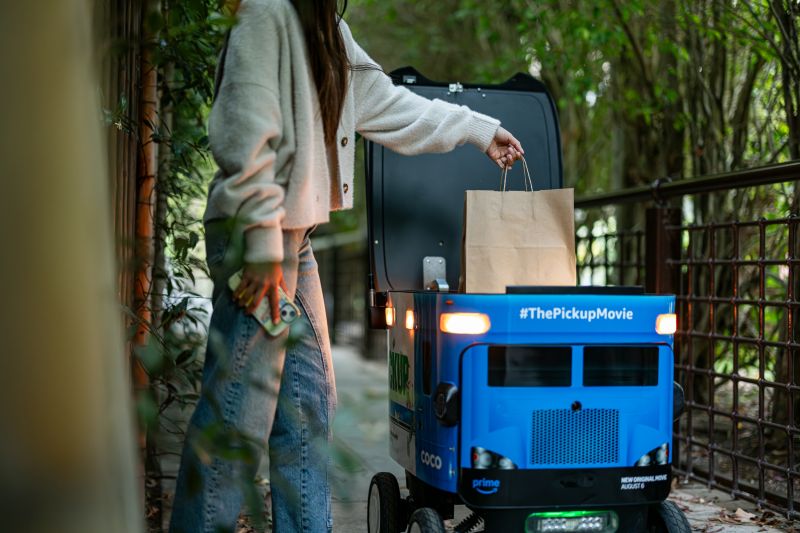
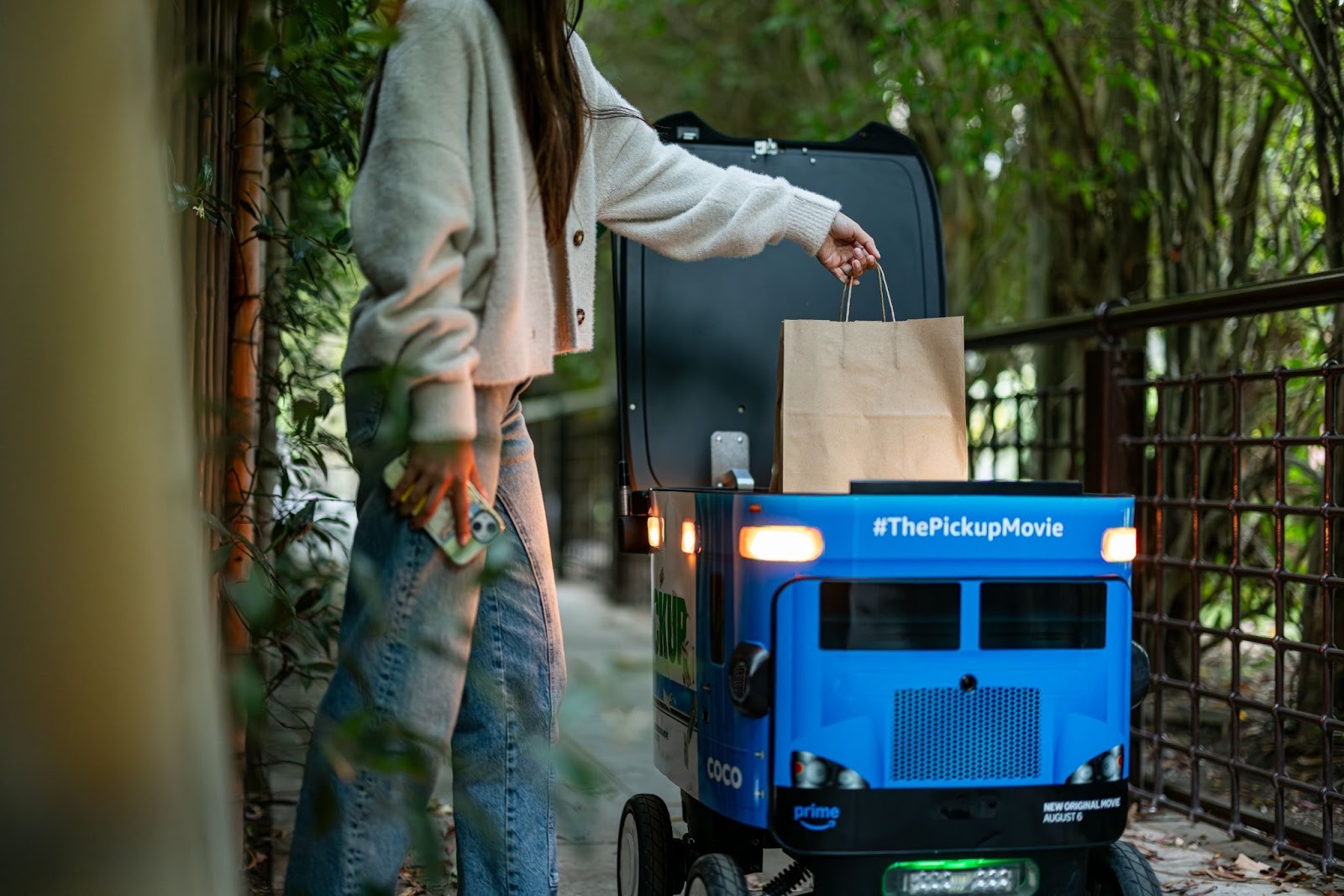
Coco’s sidewalk delivery robots represent a different answer to both problems. Equipped with a proprietary, continuous 360-degree surface, they operate as neighborhood-level media units that move along the same sidewalks and streets people use to eat, shop, commute, and socialize.
In 2025, Coco partnered with StreetMetrics to measure how these robots behave as a media network across Los Angeles, Miami, and Chicago. The data cover hundreds of robots, hundreds of thousands of miles, and billions of measured ad impressions across the three markets.
The findings point to a few important insights for the broader OOH ecosystem.
Robots Behave Like A Living Network, Not A Static Inventory Map
Traditional OOH is sold as a collection of individual units. You buy a subset of panels from an inventory list and then extrapolate reach and frequency from modeled data.
Coco robots behave differently. They function as a living network that continually re-wires its pattern of coverage as routes, restaurant partners, and delivery demand shift. The more robots are active, the more of the city they collectively touch. While the network dynamically adapts to demand, it also operates within defined neighborhood footprints that planners can intentionally select.
Insight 1: Scaling robots scales unique people reached, not just impressions
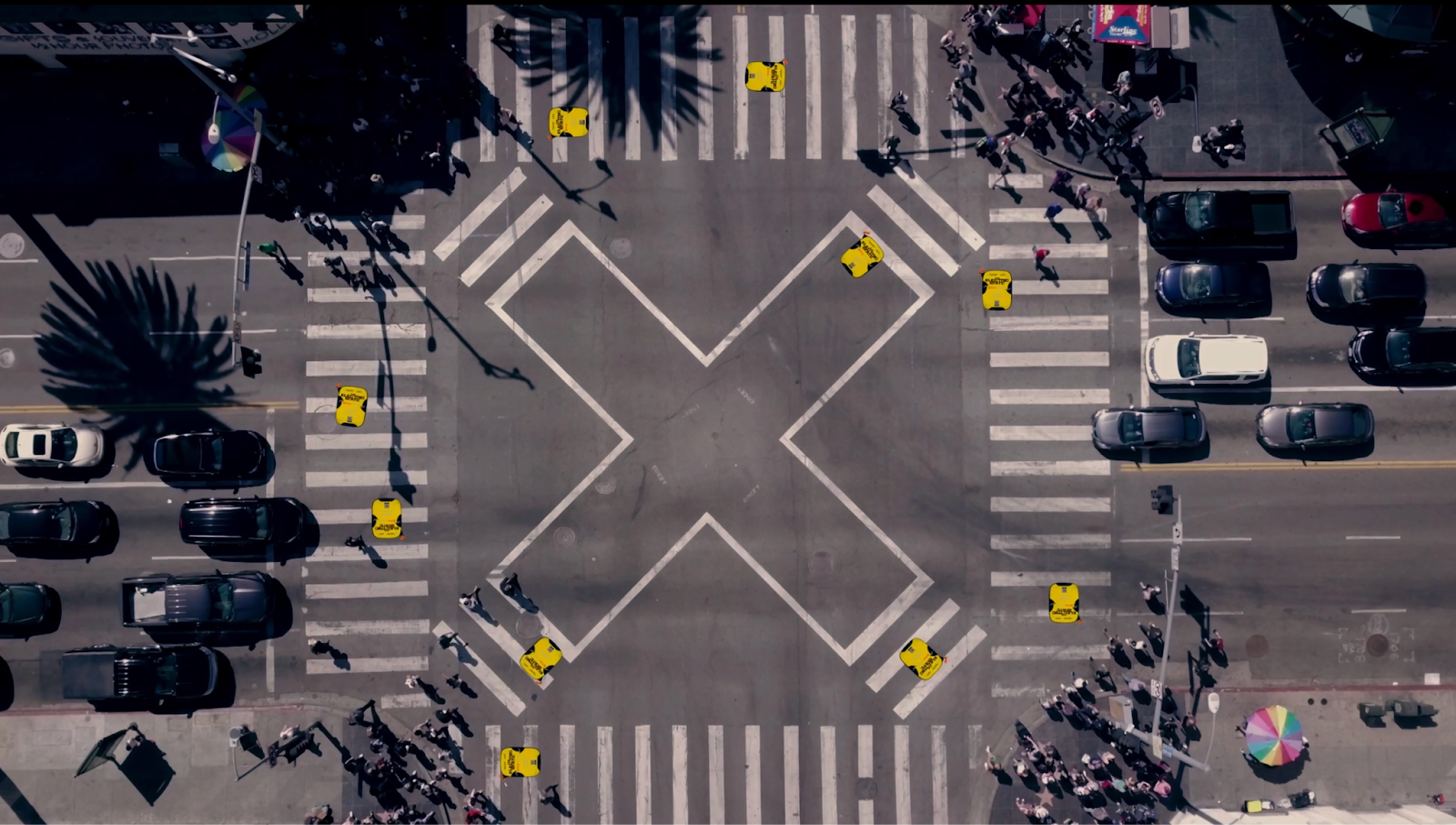
When Coco looked at month by month performance, a very consistent pattern emerged:
- As the number of active robots in a given month grew from the tens to the hundreds, total reach in that month increased several times over
The key point is not the exact curve, but the behavior:
- Adding robots does not simply add redundant impressions on the same people.
- Instead, each increment opens up new neighborhoods, routes, and times of day.
For media planners, that changes how to think about network building. With static OOH, adding a tenth board might mainly drive more frequency on an already saturated commute route. With Coco, adding ten robots in new neighborhoods often behaves more like opening a new zone in a transit system.
Insight 2: Robots fill in the “missing grid” of OOH
The impression density maps in Los Angeles, Chicago, and Miami show this vividly. Coco robots accumulate impressions across:
- High profile retail and entertainment corridors
- Residential adjacent streets that have limited or no billboard coverage
- Walkable restaurant districts that fall between freeway-based coverage zones
Instead of hugging a few arterials, robots paint a fine-grained mesh of activity at sidewalk level. That mesh is the missing layer between large-format OOH and digital media. It is where a lot of actual decision making around food, entertainment, rideshare, and quick commerce happens.
Multi Robot Exposure Without Creative Burnout
Most advertisers accept that OOH works best with repeated exposure. Traditional OOH delivers frequency along predictable routes. Coco builds frequency differently — through neighborhood movement & varied daily routines — spreading exposure across more real-world contexts instead of concentrating it in a single commute.
In practice, Coco robots show a different pattern. The StreetMetrics analysis tracked what happens to people who see Coco more than once in a given period.
Insight 3: People see many different robots, but rarely more than one a day
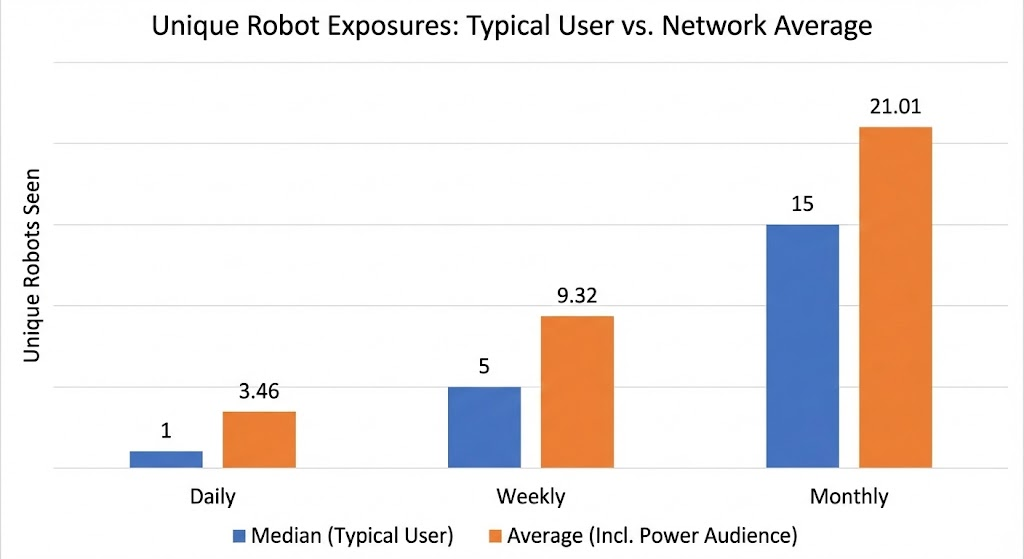
Among people who are exposed more than once:
- On a given day, most people encounter at most one ad-supported robot.
- Over the course of a month, those encounters add up to roughly 21 unique robot units per person.
In other words, the system produces:
- High creative variety over time, but
- Low daily repetition at the unit level.
That is very different from seeing the same static board every weekday commute.
Insight 4: The timing between exposures looks like spaced repetition
The study also looked at how much time passes between these unique robot encounters. For example:
- For people who ultimately see two unique robots, the average gap between exposures is around a day and a half.
- For those who see more robots across a month, the average interval tightens, but still stays close to one day between exposures.
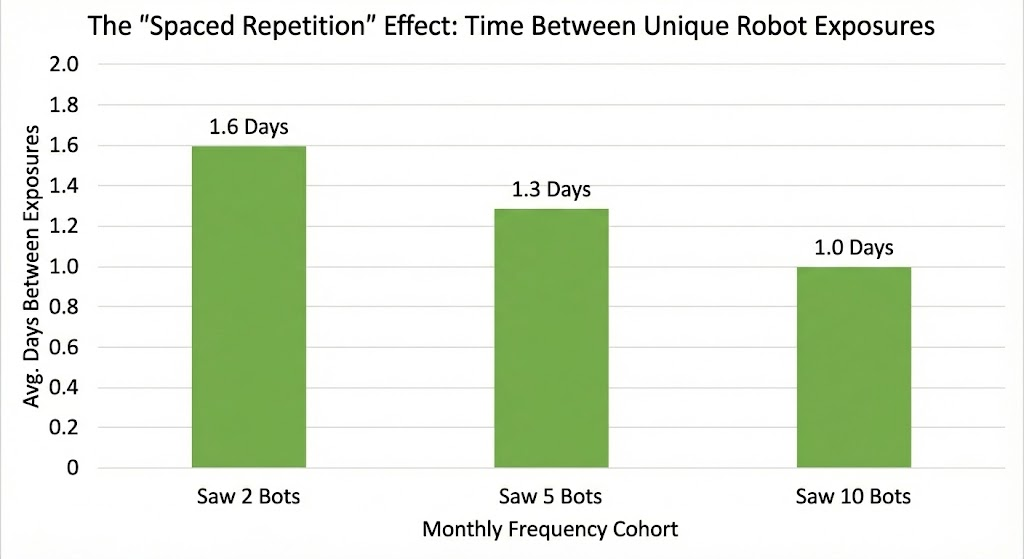
This pattern resembles the concept of spaced repetition that is often discussed in learning science. Exposures arrive often enough to reinforce memory, but not so frequently that they blur together or feel spammy.
For brands, that opens up several possibilities:
- Use robots as a real world “playlist” of creatives, where people encounter different executions across their daily routines.
- Run several creative territories in parallel for the same brand without fear that one execution will completely dominate.
- Support sequential storytelling, since there is a good chance that viewers will see multiple versions over the span of a month.
Coco’s Performance Compared With Traditional OOH Patterns
Coco is not the only moving OOH format, but it behaves meaningfully differently from buses or rideshare tops.
Insight 5: Robots combine mass reach with neighborhood level intimacy
Across the three markets, the measured network delivered:
- 100s of million OTS impressions
- Billions of gross impressions
In reach terms, always on Coco activity in key markets like Los Angeles and Miami is able to reach a meaningful fraction of the adult population over time, with GRP levels that compare to strong traditional OOH programs.
Yet the way those impressions are earned is very different:
- Robots are present at eye level, on sidewalks, often within a few feet of pedestrians.
- Cocos are unusually noticeable objects with distinctive 360-degree wraps that offer unmatched visibility, which leads to photography, conversation, and word of mouth that static panels rarely trigger.
- Their routes intersect with restaurants, residential blocks, and local retail in a way that billboards and even many street furniture units cannot.
Traditional OOH captures frequency along routine trips. Coco reinforces that exposure and expands it into additional moments across daily neighborhood life.
Insight 6: Daypart distribution lines up with “choice moments”
StreetMetrics broke impressions out by time of day. A large share of activity falls in the afternoon and evening windows:
- Morning accounts for a bit less than a quarter of impressions.
- Afternoon and evening together account for the majority, with notable peaks in early afternoon and in the 6 pm to 11 pm range. These peaks closely mirror delivery demand and at-home activity, reinforcing that robot exposure clusters around moments when people are actively making consumption decisions.
These are the hours when people are deciding what to eat, what to stream, where to go, and what to buy later online. For categories like quick-serve restaurants, cpg, food delivery, alcohol, streaming, and entertainment, that alignment matters more than sheer tonnage.
In short:
- Traditional OOH is excellent at capturing routine commutes.
- Coco is excellent at capturing choice moments: heading to dinner, leaving a cinema, walking in a neighborhood, waiting for a rideshare.
- This creates a unique 1x1 experience: engaging people upon delivery at eye-level with a personal interaction that stands out from the surrounding noise.
Incremental Reach In The Most Saturated OOH Market
One natural question is whether a format like Coco is mostly duplicative of existing billboards and street level OOH.
To answer that, Coco and its measurement partner ran an incremental reach analysis in Los Angeles, one of the most competitive and saturated OOH markets in the world. The analysis compared:
- People reached by stationary units in the system
- People reached by Coco robots
- The overlap between the two
The result was clear: adding Coco on top of traditional OOH produced incremental reach lift, even in a market already dense with billboards, transit media, and street furniture.
This aligns with what the industry has observed in other moving formats, such as wrapped vehicles and rideshare tops. What makes Coco notable is where that incrementality comes from.
The difference comes down to route geometry. Traditional OOH is constrained to permitted roadside locations and major corridors. Large portions of residential streets, neighborhood retail corridors, and restaurant districts sit beyond that footprint.
Coco operates inside those areas. Robots travel at sidewalk level, move at lower speeds, and intersect daily neighborhood activity around food, errands, and social plans. In many of these locations, robots are the only physical media present, which is where incremental reach is created rather than duplicated.
Because these encounters happen close to pedestrians — and often culminate in the moment someone receives a delivery — exposure tends to be eye-level and personal, frequently one-to-one or one-to-few, instead of one-to-many along a roadway.
From a planning perspective, the implication is simple:
- Coco is best treated as an incremental layer on top of existing OOH, not a replacement.
- In markets where OOH is already “maxed out,” robots provide new growth in reach rather than simply stacking more impressions on the same audience.
What This Means For Brands And Agencies
The data set behind Coco’s 2025 performance is specific to one network and three cities, but the underlying insights generalize to how robot media can work in any dense urban market.
How to position Coco robots in the media mix
- As a mass reach driver:
With billions of gross impressions and GRP levels comparable to primary OOH programs, Coco can serve as a core volume layer in a campaign—delivering scale similar to billboards, but at eye-level. - As a reach extender:
Use robots to fill in neighborhoods and dayparts that traditional OOH and CTV do not fully cover. - As a creative amplifier:
Utilize Coco’s unique, seamless 360-degree wrap for immersive, full-body branding, and capitalize on the fact that the average exposed person sees around 21 different robots in a month. That creates room for multiple creative territories, sequential storytelling, or multiple products under one brand without dilution. - As a neighborhood storyteller:
Coco robots are physically present where people live, walk, and socialize. That presence is well suited to local proof concepts like “seen in your neighborhood,” store or restaurant openings, or city specific creative.
Planning and optimization guidelines
Based on the 2025 findings:
- Think in networks, not in units
The relationship between robot count and reach behaves more like a growing mesh than a list of individual boards. Plan into coverage goals by market, not just counts. - Lean into creative diversity
Because users see many different Cocos but few per day, there is little risk in testing several creative assets. The risk of under-exposure per creative is lower than with static OOH. - Use daypart and audience cuts for refinement, not basic justification
The temporal and audience analyses, such as movie goer exposures clustering at late evening hours, are useful tools for telling a richer measurement story. - Secure the Ground Game
Penetrate the neighborhoods that static units can’t reach. Use Coco to insert your brand into residential streets and walkable districts, turning general awareness into daily, eye-level interaction.
Conclusion
The story of Coco’s 2025 measurement is not just that robots can deliver billions of impressions in a year.
It is that they do so in a way that is structurally different from traditional OOH:
- A living network rather than a static grid
- Many unique units per person instead of one or two familiar boards
- Spaced repetition instead of creative fatigue
- Real neighborhood presence instead of only roadside visibility
- Incremental reach on top of some of the most saturated markets in the world
For brands and agencies, Coco is not just another format. It is a way to update how OOH behaves inside the city, so that physical media aligns more closely with the way people actually move, decide, and share.